- wingtriptravel@gmail.com
- +975 - 1798-2556
- Wing Trip Tours and Treks, Thori Lam. P. O. Box 1501 ,Thimphu, Kingdom of Bhutan

about bhutan
There’s a place on earth that even the most seasoned travelers consider a privilege to visit. And, although it is voted one of the world’s top destinations, very few make it. This is DrulYul, Bhutan, the Land of the Thunder Dragon.
Where Happiness is more than a dream
You cannot find more enlightening travel destination today. Perched high on the mighty Himalayan range, the Kingdom of Bhutan has defied globalization and chosen to remain a hidden paradise, accessible only to a fortunate few.
Bhutan is marked by raw natural beauty where the dense foliage changes dramatically as the sub-tropical jungles at the sea level merge into a fertile temperate zone and rise up to the great northern glaciers. This pristine environment is home to exotic wildlife and is a last refuge for endangered species like the Snow leopard, the Blue Sheep, the Golden Langur, the Black – Necked Crane, even the Royal Bangal Tiger.
Bhutan is the last bastion of Vajrayana Buddhism, a spiritual practice that is known to be one of the most profound schools of teaching in the Buddhist world.
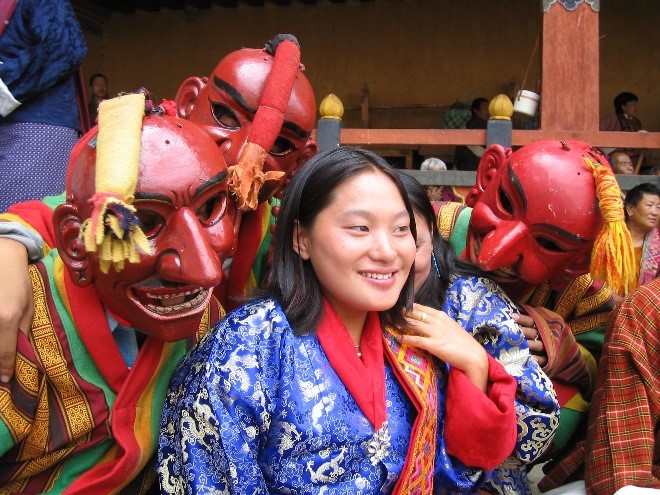
The sacred monasteries that sit precariously on the sheer cliffs, the fluttering prayer flags that line the high ridges, the red robed monks who chant through the day and night, give this Kingdom an aura that comes from another time.
The people of Bhutan have drawn a rich culture from this heritage and made it the essence of their unique identity. They have decided that man can only survive, and truly live, by being in touched with the past, the onslaught of globalization is balanced with the values that have kept human society together through the ages.
It is no surprise that the main goal in life for the Bhutanese people is Happiness. Even the mandate of the modern Bhutanese state is Gross National Happiness. In translation, this means that economic development, a goal for much of humanity, is only a means to the real goal of happiness.
The Kingdom of Bhutan, today may be man’s last unventured destination. That is how the Bhutanese people would like to keep it. Thus, the carefully controlled tourism policy of the Bhutanese government that says, in essence: take nothing but pictures, leave nothing but footsteps.
“Bhutan is determined to be guided by the values and priorities that have helped it to remain a unique country in a rapid changing world.”
Capital
Districts (Dzongkhag)
Area
Population
Time Zone
Language
Currency
Country Dialing Code
Thimphu
20
38,394 sq km
742,737
6 hours ahead of GMT
Dzongkha (official) English widely spoken
Ngultrum (Nu.)
+975
Where Happiness is more than a dream
Bhutan has evolved from feudal society that was sparsely scattered over the rugged mountain terrain, to a polity governed jointly by the clergy and civil administration, to a progressive farming society in a relatively short time. The Land of the Thunder Dragon entered the new millennium with a modern bureaucracy trying to resist being completely overwhelmed by the forces of globalization. Until the 20th century the leadership of the country was mostly mythological figures. The eight-century saint, Guru Rinpochoe, introduced the Buddhist culture that still binds society today, and Zhabdrung Ngawang Namgyal the notion of nationhood in the 17th century. The establishment of hereditary monarchy in 1907 established Bhutanese history as it is best known.
The first two Kings, Ugyen Wangchuk and Jigme Wangchuk, consolidated the nation under the absolute monarchy with a traditional hierarchical culture of governance. The Kings ruled the people directly from the royal court and the largely rural society developed along the leadership between the King and the people, the king’s responsibility being to look after the people and the people owing him their reverence.
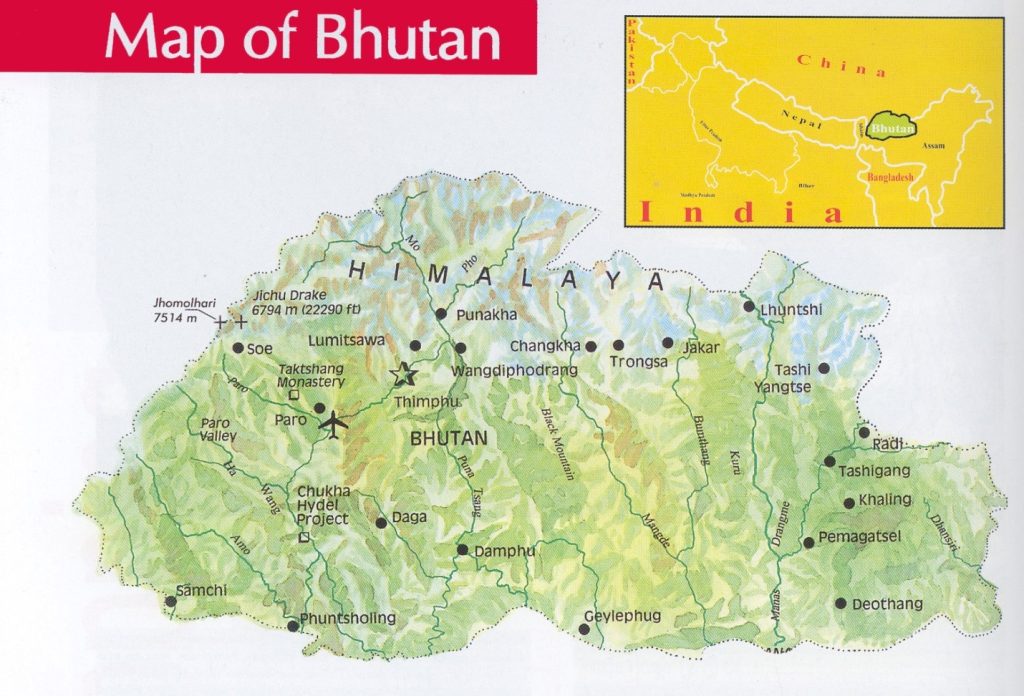
All this time Bhutan, located between China and India, felt the perceived threat of small countries and chose to remain in complete isolation with no contact with the world.
The third king introduced the concept of modernization in the 1050s and began the formal process of planned modernization in 1961. India became the main supporter and Bhutan gradually opened up to the world by establishing links with United Nations in 1972 and, eventually, 21 other countries.
The fourth king of Bhutan, Jigme Singye Wangchuk, took over in 1972 and accelerated the development process. The country saw phenomenal achievements as it built roads and bridges, schools and hospitals, tele-communication and power infrastructure. Although the traditional agricultural lifestyle is still promoted, modernization today also means that more Bhutanese are living in cities and towns.
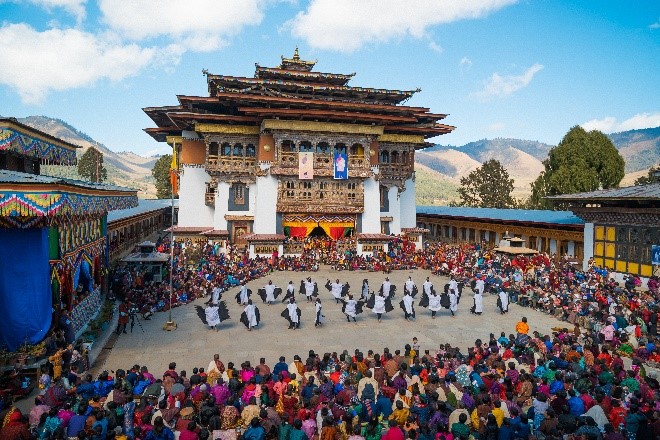
The land of Thunder Dragon now stands on the threshold of historic change as the traditional monarchy makes dramatic transition into a democratic constitutional monarchy. Society is being restructured to respond to new policies and a nation ruled by modern laws.
Throughout this process of evolution, however, Bhutan is determined to be guided by the values and priorities that have helped it to be a unique country in a rapid changing world.
“Gross National Happiness is a profound message to the world today, a world where people are said to have lost their souls in the chase for material comfort”
On the wings of change
Bhutan is a unique land in a unique time. Having survived the centuries by maintaining a distinct identity, the kingdom hopes to face the future by drawing on its past.
Change, represented by the powerful force of todays globalization, is a treat for a small country in a big world. And, accepting that change is inevitable, Bhutan hopes to survive by clinging on to age-old values that the rest of the world has lost. Television and internet were introduced for the first time in 1999, and in 2005, a record 13,626 tourist visited Bhutan.
Bhutan took a momentous step in 2008 and made the transformation from a hundred-year-old monarchy to parliamentary democracy. The 672425 Bhutanese people elected a new government in March. And in July, the king of Bhutan, the elected members of parliament and the national council adopted and signed Bhutan’s Constitution.
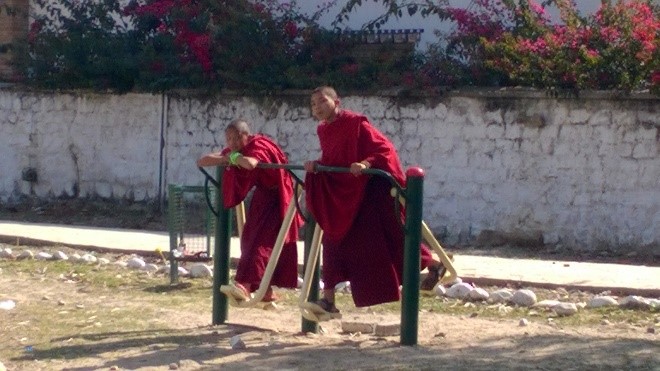
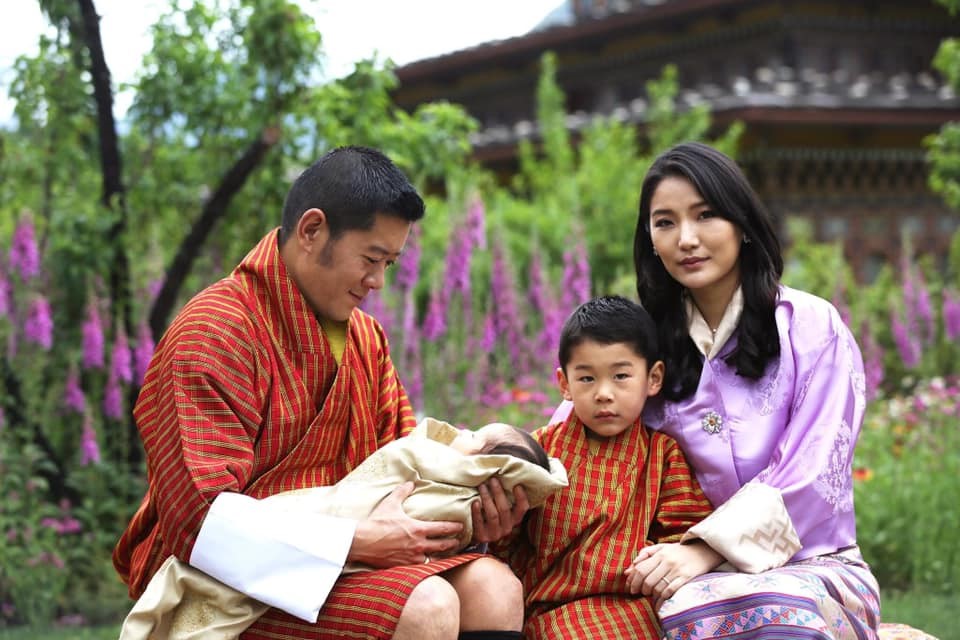
In the words of His Majesty King Jigme Khesar Namgyal Wangchuck, the power that the people of Bhutan reposed in him and his forefather has now been handed to the people.
His Majesty took over the mandate of the state in December 2006 from his father, the forth King of Bhutan, His Majesty Jigme Singye Wangchuck. The coronation of the Fifth King of Bhutan took place in November 2008 in a scared ceremony followed by nation wide festivities as Bhutan and its people celebrates 100 years of phenomenal growth under the Wangchuck dynasty.
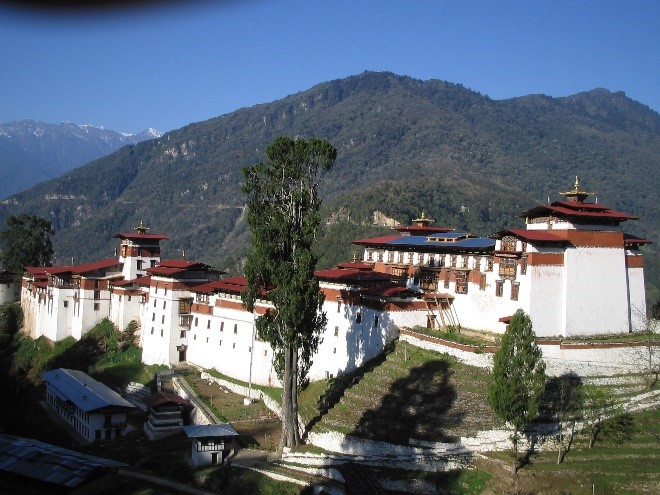
Bhutan knows that leap into a new page in history will not be easy. That is why the Kingdom stresses, more than ever before, the need to maintain its pristine environment, its rich culture, and a sacred heritage that influences the daily lifestyle of the people. That is why Bhutan is a different world today. The majestic snow-capped peaks are un-climbed because they are considered and abode of gods; the forest cover is rich because the people see plants and animals as important life forms. The people consider their unique identity their strength.
Like the country’s clear sighted “High value Low Volume” tourism policy, modernization is carefully planned and controlled to avoid the ravages of material development. The priorities are cautiously mapped so that progress is balance between tradition and modernity.
All this is conveyed in a development philosophy inspired by King Jigme Singye Wangchuck of Bhutan and known as Gross National Happiness. Drawn from the teachings of Buddhism, Gross National Happiness is a profound message to the world today, a world where people are said to have lost their soul in chase for material comfort.
snowcapped peaks, dense forested hillsides and river valleys, and the sounds of birds and gushing streams, flowing down to the temperate river valleys from the melting snows of the mighty Himalayan peaks. Trekking provides an excellent opportunity to experience the real heart of Bhutan and gain insight into the rural culture of the kingdom.