- wingtriptravel@gmail.com
- +975 - 1798-2556
- Wing Trip Tours and Treks, Thori Lam. P. O. Box 1501 ,Thimphu, Kingdom of Bhutan

Menu
LIVING AND TEXTILE TOUR
Tour Overview
Textile is an embodiment of Bhutanese cultural heritage and a staple identity of the Kingdom. This Textile Tour takes you to the remote villages in east Bhutan where many guests do not travel and that is reason enough to go.
The centuries preserved art of weaving and embroidery are largely identified as Bhutan’s premier handicraft. The kishuthara (woven silk kira) with its origin traced back to Khoma village in Lhuentse is one such textile that is highly-priced in the market today for its meticulous production. You can see weavers in their loom in Khoma. The skills that weavers portray through these textiles are immaculate and justifies why weavers in the Royal court were hired from this remote village.
Similarly, bura or find raw silk textile is endemic to Radhi, a small remote village in Trashigang. You will see the production of bura textiles using the traditional back-strap loom along with the traditional art of dyeing, weaving, and stitching.
This tour covers west Bhutan, central Bhutan – Trongsa and Bumthang, and the east – Mongar, Lhuentse, and Trashigang, with a one-way domestic flight from Yonphula to Paro. If you have missed the views of the Himalayas on your flight from Kathmandu to Paro, here is another opportunity. The flight offers magnificent views of the northern Himalayan mountain ranges of Bhutan. You can also see the lateral highway and rivers flowing down the valleys. The flight is a sweet bonus to the trip.
If you are traveling to Paro from Delhi or Kathmandu, you will see the Himalayan Mountains from the flight including the famous Mount Everest in Nepal and the majestic Jomolhari and Jichu Drake peaks few minutes before reaching Paro valley. Make sure to book left side seats to get these amazing views. On arrival, you will be greeted by the guide. If your flight is in the morning you will visit the Rinpung Dzong meaning “fortress of the heap of jewels”. It has a long and fascinating history. This fortress is visible throughout the valley with its high walls, big stone-paved festival ground, and chapels with striking architecture. Along the wooden galleries lining the courtyard of the Rinpung Dzong are fine wall paintings illustrating Buddhist lore. You will walk downhill to the road point crossing a traditional wooden bridge. Your vehicle will be waiting here to take you to Kyichu Lhakhang, Bhutan’s oldest and most sacred temple in the country. The evening is at your leisure, you can explore Paro town on foot.
Overnight at a hotel in Paro.
Today we will do sightseeing Thimphu – visit to National Memorial Chhorten, Weaving Center, Textile Museums, Bhutanese Paper factory and School of Tradional Arts and crafts. Lunch will be served in one of the restaurant in Thimphu. In the afternoon, we will do the short hike-wangditshe hike. The hike starts from BBS tower and ends at Dechenphodrang, through pine forest.
The hike will take about 1hour 30 minutes. From this hike we can see the whole Thimphu town so beautifully. Evening we will visit the Thimphu Tashichhoe Dzong.
Dinner and overnight stay at Thimphu hotel.
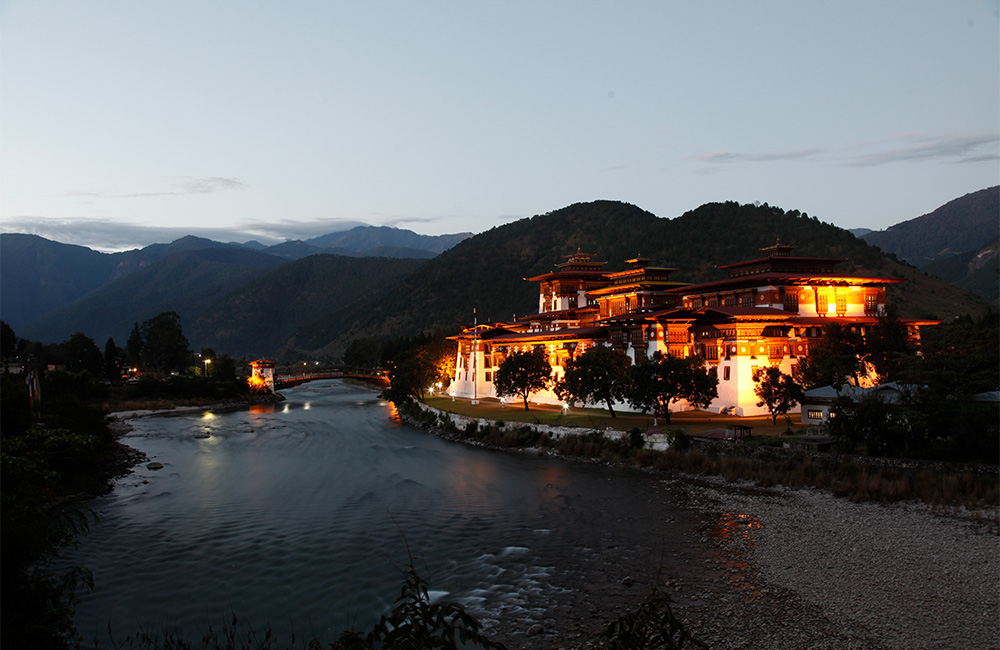
After breakfast this morning, enjoy a scenic drive to Punakha with a stop for tea at the Dochu La pass at 3140m, where on a clear day you can get spectacular views of the Himalayan giants in the north. The pass is adorned with 108 chorten stupas making it one of the most photogenic pass in the country. From the pass, we drive downhill through forests of rhododendron, fir, and hemlock. You will arrive at Punakha after traveling through rice fields and along the banks of the Punakha River. On the way, you will stop at Metshina Village and take a 20-minute walk through the rice fields to Chimi Lhakhang, which is a fertility temple, dedicated to the Divine Madman, a man who was known for his earthly sense of humor and non-conventional methods of imparting teachings. After lunch, visit the Punakha Dzong, which is stunningly situated in between the male and female rivers like an anchored ship.
Overnight at a hotel in Punakha.
Your journey from Punakha to Trongsa will take you through various scenic locations. You will reach a Pelela pass, marking the western and central Bhutanese border.
On your trip forward, you will pass via Rukubji and Sephu villages and the Chendebji Chorten, which has the same architectural design as Kathmandu’s iconic Bodhi Pagoda.
We will also get time to do some short walks and bird watching along the way.
Overnight at a hotel in Trongsa.
In the morning, take a tour to Trongsa Dzong, the country’s largest stronghold with a watch tower that represents the pinnacle of Bhutanese design before departing. After lunch, you will begin your travel to Bumthang, which is noted for its Buddhist sacred sites.
You will pass through the Yotongla pass, into Chumey valley’s Zhungney settlement. Visit the Chumey valley in Bumthang and you’ll see women of all ages hard at work, weaving balls of yarn into colourful, intricate patterns.
These designs are called yathra (woolen) weaves, and they are a unique speciality that is found only in Bumthang, a legacy that spans back many generations.
Bumthang has long, cold winters. Thus, the thick yathra fabric keeps them warm and toasty. The people of Bumthang use yathra to make coats, raincoats, bedding material, furniture covers, and accessories. Sometimes, they create bags of specific designs with yathra weaves at the request of the customer, mostly tourists. It is no surprise that tourists are eager for this uniquely Bumthang souvenir.
Overnight at a hotel in Bumthang.
Bumthang is the general name given to a group of four valleys – Chumey, Choekhor, Tang and Ura, with altitudes varying from 2,600 to 4,000m (8,530-13,125ft). This area is home to many ancient Buddhist temples and monasteries.
You will do a walking pilgrimage of the three temples:
Jambey Lhakhang is one of the two oldest in Bhutan (the other being Kyichu Lhakhang in Paro). It was erected by the Tibetan king SongtsenGampo in the 7th century and is one of the 108 temples built by him throughout Tibet and the Himalayas to overcome a giant demoness. Jambay Lhakhang is placed on the left knee of the demoness while Kyichu in Paro is built on the left foot of the demoness.
Kurje Lhakhang comprises of three temples. The one on the right was built in 1652 against the rock face where Guru Padmasambhava meditated in the 8th century. The middle temple is built on the site of a cave containing a rock with the imprint of the Guru’s body, and is therefore considered to be the most holy. Continue on foot from Kurjey Lhakhang across a suspension bridge through small villages and farmlands. Arrive at Tamshing Lhakhang, founded in 1501 by Pema Lingpa. There are very old religious paintings around the inner walls of the temple, which was restored at the end of the 19th century.
Visit the Red Panda Brewery and Cheese factory (both Swiss Bhutan collaborations) and sample the locally produced beer and cheese. Rest of the day at leisure.
Overnight at a hotel in Bumthang.
The ethereal textile tour and your journey to Mongar are worth your Bhutan trip cost because most visitors never get the chance to see the unique lifestyle of Eastern Bhutan!
You will have the opportunity to see Thrumshingla National Park and the spectacular view of Gangkhar Phuensum on a Bhutan textile tour.
From here, the road gradually descends to the alpine valley of Sengor, with wonderful views of cascading waterfalls and the hills of eastern Bhutan along the way. Vegetation changes from alpine to subtropical with the loss of height, and bamboos and luxuriant ferns overhang the road as we drop down to the valley floor. The descent stops at 700m/2,300ft, where we cross the Kuri Chu (river). We ascend again through pine forests, maize fields and eastern hamlets to reach Mongar town, high on a gentle slope above the valley.
Trace back 12km to Gangola road junction and drive 65km to Lhuentse following the upstream Kuri Chhu River. En route you will pass a small township of Autsho and several other villages. From Lhuentse, drive for another 40km on unpaved road to the historic Dungkhar village. One of the main sites in the region is the ancestral home of the Royal Family, Dungkhar Naktshang, which is a centuries-old traditionally built mansion. It is the birthplace of the first King’s father and from this house sprung the current Royal Family of Bhutan. You will explore some of the farmhouses and even lunch at a local farmhouse. Later you will drive to Takila for a night halt.
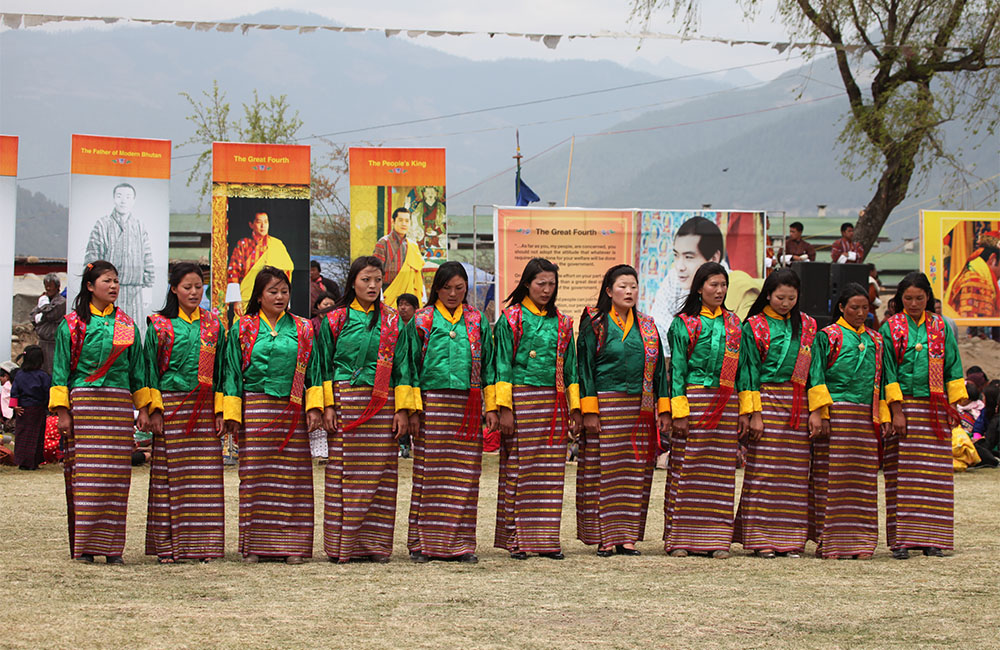
A walk to this village will truly be a pleasant trip. Situated about two hours walk from the Dzong through gentle slopes amongst pine trees, this village is known throughout the country for its woven textile, the Kishuthara. A culture that has evolved over the years is a row of women in a makeshift textile cottage, weaving intricate designs and patterns. Picking up a Kishuthara will be much cheaper than buying one from the handicraft shops in the capital.
After breakfast, you will explore Khoma Village, a unique village with an ancient cluster layout of traditional farmhouses. This village is renowned for its high-quality production of the handwoven silk textile — the Kishuthara. It is high-priced not only because of the material but also because of its intricate and meticulous designs that fill up the entire textile. The Kishuthara is highly celebrated by the Bhutanese, worn only on special occasions, celebrations and festivals. Weavers from Khoma village are praised for their nimble hands. This is how they make a living — weaving the whole day every day. Watch the women weave in their makeshift textile cottage. In the olden days, weavers from Khoma were hired in the court to weave for the Royal Family. Witness this ornate textile come to life as you walk in the streets of the village, and maybe even purchase one. Travel back to Takila for the night.
You will trace your journey back to Mongar and continue to Trashigang. From Mongar, the road ascends for a while to Kori La pass at 2400m marked by a café and a few prayer flags. As you descend from the pass you will cross Yadi, a small town. Continue your drive to cross the Sherichhu river bridge at 600m. The road from here is almost flat till Dangme Chhu river bridge from where you ascend till Trashigang. You will notice that Trashigang is a compact and bustling town that acts as a business hub in eastern Bhutan.
Overnight at a hotel in Trashigang.
Depending on the date of travel, we may have a day extra at Trashigang annual festival (21 to 23 November).
A day excursion to the Radhi Village awaits you today. After the visit to Rangjung Monastery and an exploration of Rangjung, you will drive to Radhi and Phongmey villages. They are renowned for two things — their ample rice fields and for being pioneers of the production of “Bura” textile — made of fine raw silk. Almost all households in the Radhi village make their living from Bura textiles. Using traditional weaving and dyeing techniques the village residents are skilled in producing this famous textile. If lucky, you may come across a few Brokpas; semi-nomadic yak herders from Merak and Sakteng who have come to barter their Yak butter, cheese, and dried meat with other food commodities. Later in the evening, you will drive back to Trashigang for your night halt.
From Trashigang to Yonphula, the drive takes up to a little more than an hour. It is an uphill drive passing through the villages of Pam, Rongthung, Kanglung, and then finally to the airport. The airport is at 2750m almost equal to that of Lukla in Nepal. Both airports have tabletop landing and on clear weather from Yonphula airport, you can spot Mount Jumolhari in the distance. The 35-minute flight offers spectacular views. The stunning views of the northern Himalayan ranges of Bhutan and the lateral highway and rivers flowing down the valleys.
The remainder of the day is at leisure for individual pursuits
Overnight at a hotel in Trashigang.
If you're adventurous and physically fit, get ready for a memorable hike to world-famous "Tiger's Nest" or Taktsang Palphug Monastery. Located on the face of a sheer cliff above the floor of the Paro Valley, this not to be missed site is accessible by hiking. It is a strenuous uphill climb including over 700 steps. This sacred pilgrimage site is where the great tantric mystic, Padmasambhava flew on the back of the tiger and brought the teachings of the Buddhist Dharma to Bhutan (mythical belief). The Monastery clings to a cliff soaring 3,000 feet above the valley floor at an altitude of 10,000 feet. Along the way, you can hang prayer flags for world peace, or for people who are hungry, ill or in pain (in Buddhism, a prayer flag is considered a blessing). Stop for lunch and admire the breathtaking views from the cafeteria before slowly descending. Tonight, bid a fond farewell at dinner to your Tour Manager with whom you shared this extraordinary journey in Bhutan.
Early this morning, depart from the airport in Paro to onward destination.
What is included
- Double room on twin sharing basis in government approved 3 star hotels
- Single room supplement is additional of USD 45 per night per room
- All three meals (does not cover water and other beverages ordered in hotels/restaurants)
- Bottled mineral water for the entire trip (except water ordered in the hotels and restaurants)
- Afternoon tea and snacks
- English speaking and knowledgeable guide
- Comfortable SUV and a reliable driver
- Museum entrance fees
- Visa fee and processing charges
- Tourism Development Fund
- Government taxes
- All administrative cost
- Full service & assistance before, during and after your Bhutan trip
Not included
- Airfare to and from Bhutan (we can arrange you tickets for you if you wish)
- Any other beverages (alcoholic or non-alcoholic) including water ordered in restaurants and hotels
- Travel or health insurance
- Wire transfer
- Laundry
- Gratuity/Tip for guides and drivers