- wingtriptravel@gmail.com
- +975 - 1798-2556
- Wing Trip Tours and Treks, Thori Lam. P. O. Box 1501 ,Thimphu, Kingdom of Bhutan

Menu
Soe Yaktsa Trek
Enjoy one of the world’s most spectacular descents as your flight arrives into Paro amid breathtaking views of the Himalayan peaks. On arrival you will be greeted by your WING TRIP tour guide, who will remain with you throughout your journey across Bhutan. Your itinerary will be tailored to remain as flexible as possible and you will be able to discuss it in advance.
An hour drive away, Thimphu, Bhutan’s capital lies in a steep valley at an altitude of 2300m (7000ft). Upon arrival to Thimphu, you will have time to settle in before exploring the areas, including National Library, Textile Museum, Weaving Center, Buddha Point and the National Memorial Chorten. Depending on your arrival time, you may also be able to visit the Institute of Traditional Medicine, the School of Arts and Crafts, folk Heritage and Simply Bhutan – museum depicting Bhutan’s ancient cultural heritage.
Alternatively, opt for a mild hike with a good view, such as the Wangduetse Leisure Forest trail.
Overnight in Thimphu.
Thimphu, perhaps the most unusual capital city in the world also serves as the seat of government.
This bustling town is home to Bhutan’s royal family, the civil service, and foreign missions with representation in Bhutan. It is also the headquarters for a number of internationally funded development projects.
Today’s full day of sightseeing in Thimphu valley includes visits to:
* Buddha Dordenma statue sitting on top of a hill overlooking Thimphu. The Statue of Sakyamuni Buddha is one of the tallest in Asia (51.5 m). The site of Buddha Dordenma offers unobstructed views over the capital town.
* The National Memorial Chorten- the building of this landmark was originally envisaged by Bhutan’s third king, His Majesty Jigme Dorji Wangchuck, who had wanted to erect a monument to world peace and prosperity. Completed in 1974 after his untimely death, it is both a memorial to the Late King (“the father of modern Bhutan”), and a monument to peace.
* Folk Heritage and Textile Museums: These museums, both of which opened in 2001, provide fascinating insights into Bhutanese material culture and way of life.
* Institute for Zorig Chusum: Commonly known as the Painting School, the Institute offers a six-year course on the 13 traditional arts and crafts of Bhutan. On a visit one can see students learning the various skills taught at the school.
* Handicrafts Emporium: This government-run enterprise displays a wide range of beautifully hand-woven textiles and craft products. It also carries a small collection of books on Bhutan, Buddhism and Himalayan culture.
* National Library, which holds a vast collection of Buddhist texts and manuscripts, some dating back several hundred years, as well as modern academic books mainly on Himalayan culture and religion.
In the evening, take a stroll along the town’s main street.
Overnight at Hotel.
An early departure will be necessary for the dramatic drive over the 0350m mountain pass Dochu La, from where towering Himalayan peaks are visible on a clear day. Sights on the way to Punakha Valley include one of Bhutan’s first fortress monasteries, the 17th century Simtokha Dzong.
Punakha lies at the altitude of 1250m (4100ft) in a warm fertile valley at the junction of Mo Chhu (Female River) and Pho Chhu (Male River). The subtropical environment allows the cultivation of rice and exotic fruits.
On the way you can visit Chimi Lhakhang, the auspicious fertility temple built in 1499, to which many couples come to pray for pregnancy and receive a wang (blessings) from the saint with the magic thunderbolt of wisdom.
A short drive through the Punakha valley, we begin our hike crossing the suspension bridge and ascending a series of switchbacks to Khasum Yueley Namgyal Temple. From this temple, there is a grand view of the Mo Chhu (Female River) valley below. We then descend from the temple and follow a well-worn path down the valley through rice fields and small villages. Along the way we are rewarded with stunning views – the terraced rice paddies providing an exotic backdrop to the river below.
After enjoying a picnic lunch along the river, we continue to Punakha Dzong. Initially built in 17th century for unifying the country, it is the second oldest fortress in the country and it served as the original capital until 1955. Today it is the home to Bhutan’s spiritual leader, Je Khenpo, who resides here with 1000 monks during winter months.
In the afternoon, we have the special opportunity to visit the Nalanda Buddhist Institute and learn more about monks live and meditation.
Retrace the path to Paro by heading westward towards Simtokha Dzong, the first dzong in the Kingdom built in AD 1629, proceeding further south towards Chuzom (confluence of rivers) Bridge where Wang Chhu and Pha Chhu meet. From here, a leisurely drive brings you to the town of Paro and onward to a family home. Once you arrive, settle in and enjoy a Bhutanese traditional lunch and do not miss homemade liquor ara and traditional butter tea.
After Lunch visit National museum and followed by short downhill walk with a beautiful view of Paro valley.
Early breakfast followed by a hike to Taktsang Goemba. (All Day)
Staring Elevation: 2400m
Gain in Elevation: 700m
Highest Point: 3100m
Total Distance: 8km (back and forth)
Stop at Cafeteria for tea and restroom facilities
Lunch on the way back at Cafeteria.
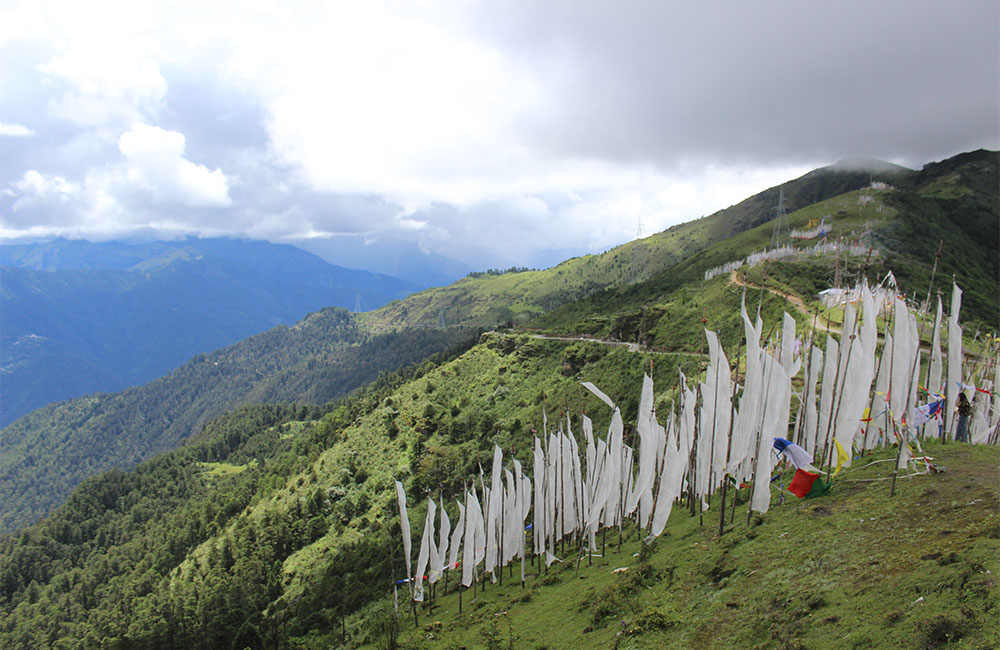
Your day begins with an energy boosting breakfast before departing to see one of the most significant landmarks and cultural icons of the Kingdom, Taktsang Goemba, known as Tiger’s Nest. This highly revered monastery was built on a sheer cliff face roughly 2,950 feet (900 meters) above Paro Valley; it is visible from the valley floor. Your guide will hike up with you to the monastery and share stories of its history. Enjoy the wonderful scenery through pine forests that are colorfully decorated with moss and prayer flags. This sacred pilgrimage site is where the great tantric mystic, Padmasambhava flew on the back of the tiger and brought the teaching of Buddhist Dharma to Bhutan in early 8th century. During cooler weather, clouds often shroud the monastery, highlighting its sanctity and remoteness. For lunch, a picnic can be arranged or you may opt to dine at a local restaurant in Paro town followed by some last-minute shopping. If energy levels permit, visit the Kyichu Lhakhang, a 7th century sanctuary that is an absolute gem for historians and art connoisseurs. It is said to have two magical orange trees that bear fruit throughout the year. Along the way hang some prayer flags for peace and to mark your journey in the Kingdom of Bhutan.
Today, we will drive up to Drugyel Dzong or Gunitsawa village at the altitude of 2750m, through ruins of Drugyel Dzong, built in 1649 to commemorate the victory over Tibetan invasion. The drive will take 1 hour and 30 minutes; once we reach at Drugyel Dzong then we will drive through the feeder road almost for 1 hour. On reaching at Gunitsawa village, there is an Army Check Post. Out here, your trekking permit (provided by your tour operator) will be checked and endorsed. From here, we will start our trekking, but today we will trek just for 1 -2 hours. Once we reach at Shana Zampa, we will meet with our crew members. Dinner at the campsite.
Distance 5-9 kms, 4-5 hrs/ 50 – 60mins, 80 m descent and camp altitude 2,750 m.
This trek begins at Gunitsawa Village were you pass the army post. At the army check post your trek permit (provided by your tour operator) will be checked and endorsed. The campsite is on the opposite side of the river, not far from Gunitsawa.
Distance 22 km, 8-9 hours, 770 m ascent, 10 m descent and camp altitude 3,560 m.
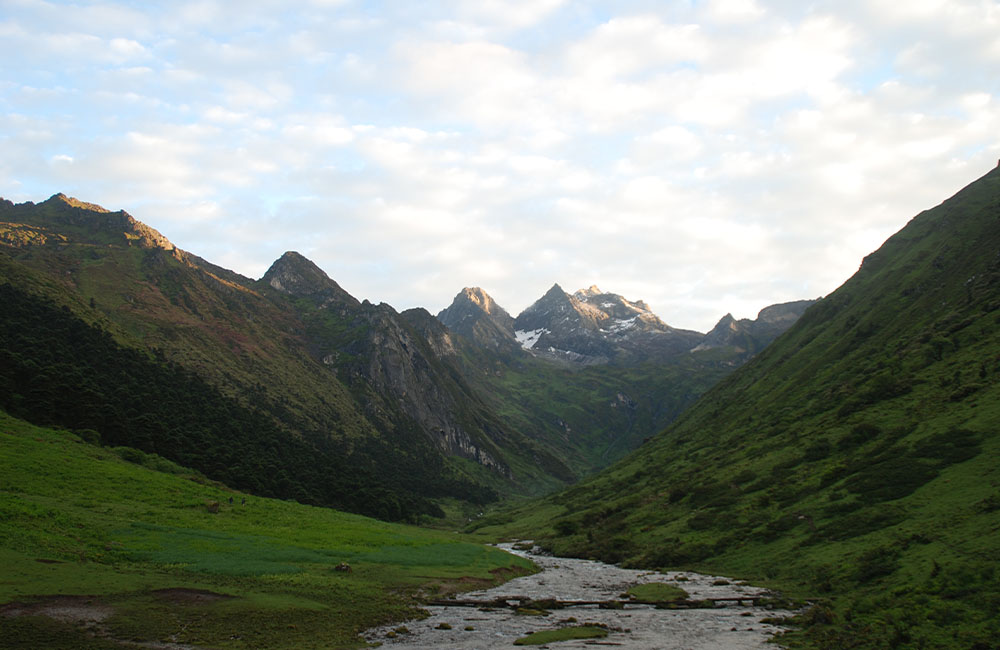
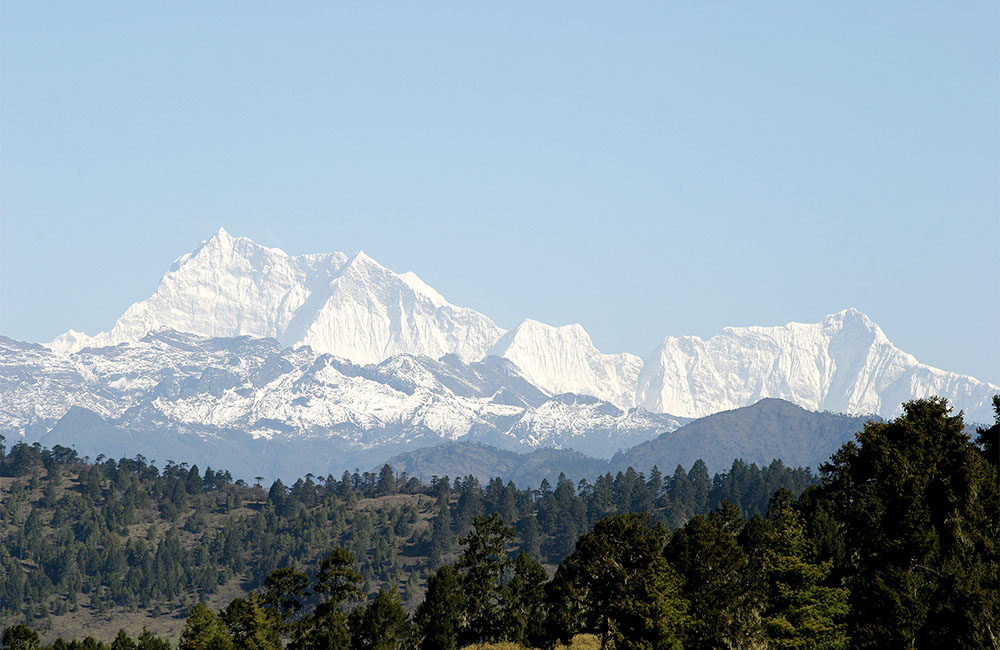
On this long day, the trail continues with lots of small ups and downs. After going uphill through the river valley the valley finally narrows gradually to a mere path which descends to a meadow where a camp will be set up. From here, if weather permits, you will have the first great view of Mt. Jomolhari.
The trail again follows Pachhu (Paro river), ascending and descending through pine, oak and spruce forests. After 2 hours of continuous hiking and crossing several streams, you will reach at Shingkharap, a stone house at 3110m. A hot lunch will be served after crossing the bridge towards the left side of the river. Little ahead is a trail junction – left an old trade route and invasion from Tibet and right leading to the wooden bridge (we follow the right). After climbing up through rhododendron forests and finally crossing the bridge again, we reach our camp at 3560m, which is amidst beautiful meadows.
Distance 19 km, 5-6 hours, 480 m ascent and camp altitude 4,080 m.
Today you will cross the tree line at 3700m and gain significant height. From the camp, your path ascends for a while till you reach the army camp. Then follow the river above the tree line enjoying the stunning view of the surrounding peaks. We walk through a very muddy section of the trail, pass a mani wall and enter yak pastures. Hot lunch will be served inside a yak herder’s camp. After lunch, we walk past yak herder settlements of Soe and Takethang. Common crops that people grow here are barley, potatoes and turnips. We walk our final stretch across a plateau and up a stream bed and Dangochang village to the awesome campsite of Jangothang at an altitude of 4080m. From here, the views of Mount Jomolhari and Jichu Drake are superb.
Today, you will spend the day tackling a four hour acclimatization hike to the north of your camp. There is practically no trail but you will climb on an open and endless slope till you see the view of Mount Jichu Drake (6989m). You can hike further up till 4890m (higher than Mount Blanc) to see beautiful views of Mount Jomolhari. You are likely to spot rare blue sheep, Himalayan rhubarb, griffon vultures, golden eagles and the remarkable blue poppy. Jangothang base is a flat grassy land with an old ruined fortress on a hillock in the foreground, beneath the colossal Mount Jomolhari and the neighbouring Mount Jichu Drake. Most people show signs of mountain sickness at this altitude and it is recommended that all trekkers halt here. If you wish, you can also spend the day simply relaxing, regardless it will be a memorable day in the Himalayas.
Distance 16km, 6 -7 hours, 810m ascent, 1,090m descent and camp altitude 3,760m.
The trail leads north to the last settlement in the valley and drops to Paro Chu River. Cross the river on a wooden bridge and walk up to the Tshophu Lake (4380m), which is inhabited by ruddy-shel ducks. You will come across a second lake after you climb across a slope to a crest. Then descend into a hidden valley and climb steeply to Bonte La pass at 4890m. After the pass, the trail descends crisscrossing through yak trails down to the Dhumzo Chhu river and after walking downstream below few houses you arrive to a camp at 3760m.
Distance 11km, 5-6 hours, 720m ascent, 340m descent and camp altitude 4,180m.
The trail climbs over 100m over a ridge, and then drops to another stream. After crossing this stream, the trail heads up the hillside dropping into a small valley before emerging onto a ridge. Here the route turns south, ascending past few huts to Takhung La (4520m). A short descend leads to Thombu Shong at an altitude of 4180m with few yak herder’s huts.
Distance 13km, 4 -5 hours, 200m ascent, 1,650m descent and camp altitude 2,760m.
Climb out of the valley to Thombu La pass at 4380m, and then drop gradually to about 4000m. The trail then makes a steep descent, switching back down the ridge and finally reach the helipad at Gunitsawa (2730m). Your vehicle will be waiting here to pick you up. Drive to Thimphu where you can celebrate your return to civilization with a refreshing shower in the hotel. Overnight at a hotel in Paro.
Finalize your packing, check out and depart for airport
Although it is sad to leave the “Happiest Place on Earth”, an early departure is necessary since all flights depart in the morning. After an early breakfast, your 30-minute transfer to the airport will be arranged by your guide to coordinate with your flight schedule.
What is included
- Double room on twin sharing basis in government approved 3 star hotels
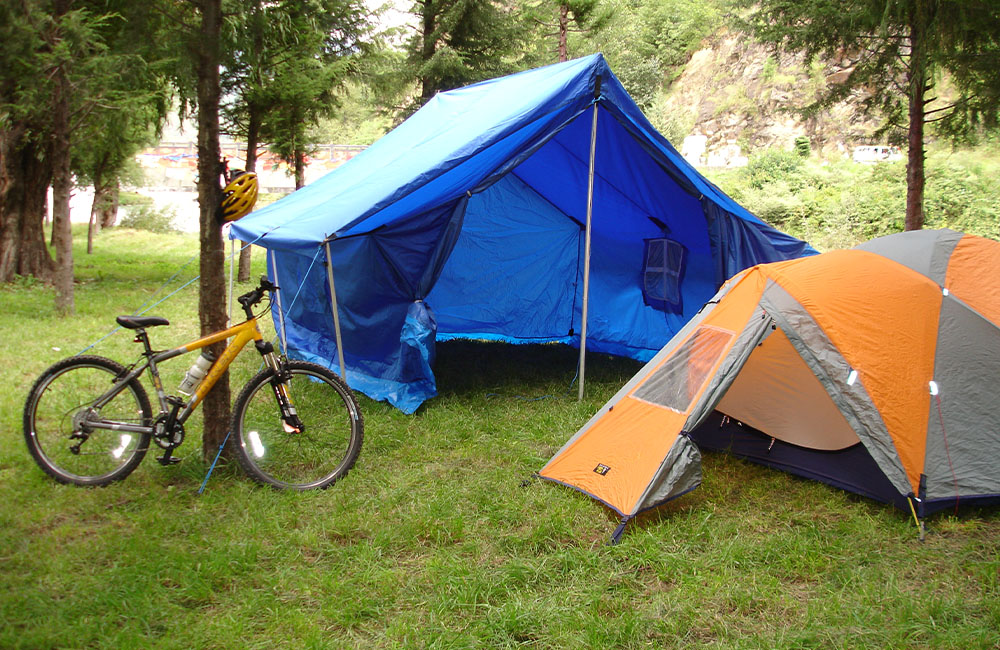
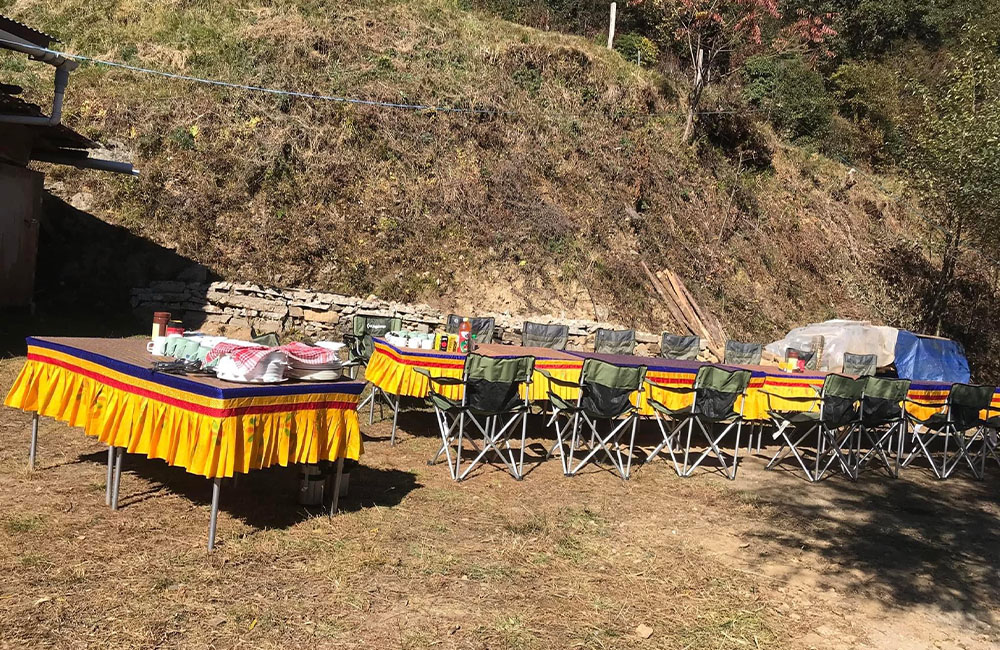
- Camping equipment and haulage for trekking tours
- Single room supplement is additional of USD 45 per night per room
- All three meals (does not cover water and other beverages ordered in hotels/restaurants)
- Bottled mineral water for the entire trip (except water ordered in the hotels and restaurants)
- Afternoon tea and snacks
- English speaking and knowledgeable guide
- Comfortable SUV and a reliable driver
- Museum entrance fees
- Visa fee and processing charges
- Tourism Development Fund
- Government taxes
- All administrative cost
- Full service & assistance before, during and after your Bhutan trip
Not included
- Airfare to and from Bhutan (we can arrange you tickets for you if you wish)
- Any other beverages (alcoholic or non-alcoholic) including water ordered in restaurants and hotels
- Travel or health insurance
- Wire transfer
- Laundry
- Gratuity/Tip for guides and drivers
Share this page :
Other Packages
Published by WING TRIP TOURS & TREKS
Copyright © WING TRIP TOUR & TREKS
No part of this publication may be reproduced without prior permission, except by tour operators working with WING TRIP TOUR & TREK. Such tour operators may reproduce sections of text for the purpose of giving out information to clients to be booked on our tours
The lovely Bumthang valley is the religious heartland of the nation and home to some of its oldest Buddhist temples and monasteries. This three-day trek passes through several villages on its meandering route through Bumthang countryside, and provides an exceptional opportunity for contact with Bhutanese rural life.