- wingtriptravel@gmail.com
- +975 - 1798-2556
- Wing Trip Tours and Treks, Thori Lam. P. O. Box 1501 ,Thimphu, Kingdom of Bhutan

Pre-Departure
TRAVEL INSURANCE
Visitors to Bhutan must obtain travel insurance that is valid for the entire duration of the trip. We recommend visitors to arrange their own travel and medical insurance coverage before departure. For Trekkers, your medical insurance coverage must include provision for evacuation by helicopter in case of emergencies. Minimum cost for a rescue helicopter costs $3500 per hour.
TRAVEL FORMALITIES
Visa clearance documentation: Visa clearance documentation will be sent you prior to your travel date. You must produce the visa approval document, travel insurance certificate and e-tickets at the time of boarding the flight to Bhutan. The actual visa stamping is done at Paro Airport. Please post these documents in your traveling mailbox. In the event you lose the papers you can always download from the mailbox.
Please make sure to travel with the same passport on which the Bhutan visa was issued. We will not be held responsible if the passport on which the visa was issued does not match the passport used to travel to Bhutan. In such an event, you will not be allowed to board the flight or enter Bhutan.
Other Country Visas: Please make sure you have the necessary visas & documents required for other countries that you may transit through or visit before/after Bhutan.
PASSPORT & VISA ARRANGEMENT
Your passport should be valid for at least six months after your planned date of departure from Bhutan.
Travel insurance certificate will have to be produced at the port of entry.
The information is correct to the best of WING TRIP knowledge at the time of publication and is being reviewed and updated on an ongoing basis.
BAGGAGE
Druk Air & Bhutan Airlines Checked Baggage Allowance (International Flight)
The checked baggage allowances on scheduled international flights are as follows:
Business Class 40 kg
Economy Class 30 kg
Infants paying only 10% of the applicable air fare are not entitled to any free baggage allowance.
Druk Air & Checked Baggage Allowance (Domestic Flight)
The checked baggage allowances on scheduled international flights are as follows:
Business Class 30 kg
Economy Class 20 kg
The following Articles may be carried free of charge over and above the Free Baggage Allowance
- A lady’s handbag, pocket book or purse, which is appropriate to normal traveling dress and which is not being used as a container to carry articles which would otherwise be regarded as baggage.
- An overcoat wraps or blanket
- An umbrella or walking stick
- A small camera and/or a pair of binoculars
- A reasonable amount of reading matter for the flight
- Infants food for consumption in flight and infants carrying basket
- An invalids fully collapsible wheelchair and/or crutches or another prosthetic device for the passenger’s use provided the passenger is dependent on them
All other articles – such as flight bags, briefcases, typewriters, ladies’ vanity cases, large size cameras, etc – will be weighed and, if applicable, excess baggage charges will be levied.
Unchecked Baggage/cabin Baggage Special Regulations
- Regulations issued by the Drukair & Bhutan Airlines stipulate that your cabin baggage must be placed in the overhead bin. Therefore, the overall dimensions are limited to 45 + 35 + 20 cm (17 + 13 + 8 inches). The weight must not exceed 5 kgs in Economy class and 7 kgs in Business class.
- These regulations shall ensure that the cabin baggage will not impede evacuation of aircraft cabin in case of emergency.
- Please consider this when packing your baggage and kindly ensure that any item exceeding the above limitations is sent as checked baggage.
- Spot checks will be performed during embarkation to ensure that these regulations are being followed
Baggage Guidelines
- For the purpose of easy identification, please label all baggage on the inside as well as on the outside with your name, address and telephone no.
- Name labels are available at all Drukair offices and check-in counters.
- Remember to lock your baggage to prevent it from falling open.
- The Carriers are not liable for loss of, damage to or delay in the delivery of fragile or perishable articles, money, jewellery, silverware, negotiable papers, securities or other valuables, business documents or samples or medicines or drugs which are included in the passenger’s baggage, whether with or without the knowledge of the carrier.
- Please note that all Airline Members of the International Air Transport Association (IATA) are required to observe the following baggage regulations.
Excess Baggage
The charge per kg of excess baggage is equivalent to 1.5% of the highest normal adult one-way economy class fare or as specified by the airlines.
WHAT TO PACK
The following is an exhaustive list of what you should pack for the trip. Please carefully read the sections on Climate and Clothing under General Information (below) before packing your clothing.
(1) Everyone: small day pack; proper pouch to hold your travel documents, money, air tickets and other valuable items/documents; clothes as per season, & a poncho or rain gear &/or umbrella (June-September); facecloth, soap, hair shampoo, cold water detergent, sunglasses/spare glasses, comfortable walking shoes, pocket knife, hat, camera and accessories insect repellent, hand cream, torch or flash light with spare batteries, sun cream, lip salve, soluble aspirin, antiseptic cream, anti-histamine cream, anti-diarrhea pills, a preparation for the relief of sunburn, and any medication you take regularly, or might need to take for a periodically recurring condition, such as asthma.
- There are many dogs in settled areas. They sleep in the day and roam around at night. Bring earplugs if you think their barking might bother you.
- If you wear contact lenses, bring a pair of spectacles as well, as at high altitudes contact lenses can irritate the eyes.
(2) Trekkers: In addition to the above, bring sleeping bag and Therma rest; comfortable trekking boots which have already been broken in and plenty of pairs of socks, noting that woollen socks dry quicker than cotton ones. Also bring a water bottle and plastic bags for packing clothing while on trek, as plastic bags are banned in Bhutan.
GENERAL INFORMATION
Time: Bhutan time is 6 hours ahead of GMT and there is only one time zone throughout the country.
Health: Before embarking on a trip to Bhutan, please seek advice from your doctor about vaccinations and appropriate medication you should have prior to your travels. As a minimum you should have tetanus, typhoid and hepatitis A inoculations
Money: Bhutan’s currency is the Ngultrum (Nu.). The Ngultrum is fixed to the value of Indian rupees. You are advised to carry your money in the form of traveller’s checks (preferably American Express) and cash (US dollars would be best), which might be used for incidental purchases/expenses. There are bank branches in all major towns. A few hotels and shops in Thimphu accept payment by credit card, but with a surcharge added. Visas cards are more widely accepted than MasterCard or American Express. Daily expenditure varies from person to person, but in general you should allow US$5-10 daily for laundry, drinks, phone calls overseas, small souvenirs, postcards, and stamps.
ATMs (Automated Teller Machines) are not available. The government has issued a notification to banks to remove ATMs by the end of 2022 as these machines have become redundant due to the gaining popularity of digital transactions in the country.
Visitors can bring cash equivalent up to USD 10,000
Electricity: In Bhutan, electricity runs on 220/240 volts, with round hole two-pin and three-pin power outlets. If you bring electrical appliances, also pack appropriate adapter plugs. In Thimphu electrical appliance shops stock adapter plugs, but they are unlikely to be available elsewhere.
Communications: Most of the major towns and cities in Bhutan are equipped with basic communication facilities that include telephone, fax, and internet service. Most of the bigger hotels provide email, internet and WiFi facilities within the hotel premises. Visitors can get a sim card from visitor information centres on arrival, branch offices of Bhutan Telecom and Tashi Cell or from authorized agents in towns.
Accommodation: There are comfortable hotels, lodges, and guesthouses at our tourist destinations. Hotels in western Bhutan are better appointed, while accommodation establishments in the central and eastern part of the country are more modest, with fewer amenities. The hotels are categorized as 3 stars, 4 stars and 5 stars.
Alms giving: The giving of alms to mendicants and holy men in the vicinity of markets and outside temples is an accepted practice. In exchange for your contribution of a small coin, a prayer will be intoned for you. Take your cue from the Bhutanese on such occasions and, when in doubt, ask your guide what the appropriate thing would be to do.
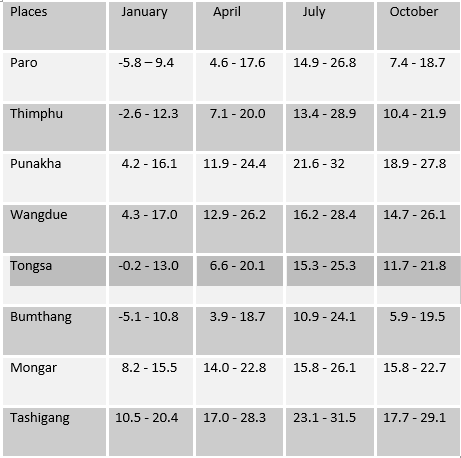
Climate: The southern part of Bhutan is tropical, and in general the eastern region of the country is warmer than the central valleys. However, bear in mind that the higher the altitude, the cooler the weather, and that with a brisk wind blowing down off the mountains, even a low-lying valley can become quite chilly.
The central valleys of Punakha, Wangduephodrang, Mongar, Tashigang and Lhuentse enjoy a semi-tropical climate with cool winters, whilst Paro, Thimphu, Tongsa and Bumthang have a much harsher climate, with summer monsoon rains and winter snowfalls which may block passes leading into the central valley’s for days at a time. Winter in Bhutan is from mid-November till mid-March, and at this time of the year the climate is dry and sunny for the most part, temperatures peaking at around 15 degree centigrade in the daytime and falling below zero at night. The monsoon usually arrives in mid-June, with light rain falling mainly in the afternoons and evenings. At the end of September, after the last of the big rains, autumn suddenly arrives, and is a magnificent season for trekking until November.
Language: Bhutan is linguistically rich with over nineteen dialects spoken in the country. The richness of the linguistic diversity can be attributed to the geographical location of the country with its high mountain passes and deep valleys. These geographical features forced the inhabitants of the country to live in isolation but also contributed to their survival.
The national language is Dzongkha, the native language of the Ngalops of western Bhutan. Dzongkha literally means the language spoken in the Dzongs, massive fortresses that serve as the administrative centers and monasteries. Two other major languages are the Tshanglakha and the Lhotshamkha. Tshanglakha is the native language of the Tshanglas of eastern Bhutan while Lhotshamkha is spoken by the southern Bhutanese of Nepali origin.
Other dialects spoken are Khengkha and Bumthapkha by the Khengpas and Bumthap people of Central Bhutan. Mangdepkah, which is spoken by the inhabitants of Trongsa and the Cho Cha Nga Chang Kha which is spoken by the Kurtoeps. The Sherpas, Lepchas and the Tamangs in southern Bhutan also have their own dialects. Unfortunately, two dialects that are on the verge of becoming extinct are the Monkha and the Gongduepkha.
Shopping: The Cottage and Small Industries (CSI) outlet, handicraft shops, the OGOP outlets, and the Centenary Farmers Market are some of the popular shopping areas for visitors. Guests are required to process export permits online [https://mocp.doc.gov.bt/] for non-antique products such as statues, ritual objects and religious handicrafts from the Department of Culture before exiting the country. For a detailed list of prohibited, restricted or declarable items, please visit the website of the Ministry of Finance [https://www.mof.gov.bt].
Clothing: Due to the wide range of temperature and climatic conditions it is advisable to dress in layers. For protection against cold, layered clothing is better than one or two thick garments.
Clothing should preferably be made from natural materials, which allow the body to breathe. Bring comfortable, well-worn clothing, and plenty of underwear and socks. If travelling in the cold season, bring two sets of silk vests and long johns, as they are warm and dry quickly after washing.
Dress modestly and respectfully for visits to monasteries, Dzongs and other religious institutions. Remove hats, caps etc. before entering, and refrain from smoking on the premises.
Photography: The photographic opportunities on all trips are immense. The natural scenery is superb, and you will also wish to record the local people, their houses, and shops etc. Always ask by a gesture if it is ok to do so. Don’t take your destination as a living museum! Also, note that photography in shrine rooms of dzongs, monasteries and religious institutions is generally not permitted. Outdoor photography is usually permitted, but when visiting such places, please check with your guide before taking any photographs.
Shopping: Hand-woven textiles, carved masks, woven baskets, wooden bowls, handmade paper products, finely crafted metal objects, Thangkha paintings and Bhutan’s exquisite postage stamps are the items mostly purchased by travelers in Bhutan. Thimphu has the most extensive range of textiles, but for Yathra (hand-woven woolen textiles), the range is greatest in Bumthang. Thimphu’s gold and silversmiths make to order, with items ready in seven days. It is recommended to carry cash such as Euro, Pounds, US dollars, Japanese Yen and related travelers’ checks for expenses in Bhutan.
The higher denomination notes have better exchange value. Credit cards are accepted in few handicraft stores and 5-star hotels.
The buying and selling of antiques are strictly forbidden. Be cautious when considering the purchase of old and used items, especially of religious or cultural significance, as such items may not be exported without a clearance certificate. WING TRIP advice should be sought before committing to such purchases. It is best to buy more expensive items at reputable shops, which provide receipts as proof of purchase.
Precautions: Bhutan is one of the safest countries in the world however you should still exercise caution. Please ensure that your belongings especially your passports, cameras, wallets, and purses are properly secured. Please refrain from leaving such items within sight or in locked vehicles while sightseeing.
Avoid drinking tap water which has not been boiled or ice cubes in drinks at all times as most water sources in Bhutan are untreated. One can easily acquire affordable treated and bottled water.
Also, Bhutan has a duty to protect its citizens from drugs and tobacco products. To do this we need your help and cooperation. Please co-operate if stopped and asked about your baggage. Please do not carry tobacco goods more than the set limit. For more information, please see following link. https://bnca.gov.bt/tobacco-control-amendment-act-2021/
There are a number of stray dogs that roam freely around the city areas. It is recommended that visitors to Bhutan do not feed or pat the stray dogs. It is also recommended that guests take care around the stray dogs and keep their distance.
Tipping: Hotel and restaurant bills include service charges amounting to 10%. There is no need to add anything further on this. WING TRIP will take care of this.
ETIQUETTE FOR VISITS TO DZONGS, MONASTERIES, TEMPLES & FESTIVALS
Clothing & behaviour: Dress neatly and modestly (covered arms, no shorts, or short skirts) and do not wear a hat in the precincts of Dzongs or religious complexes. Do not smoke. Walk clockwise around Chortens (stupas) and Mani (prayer) walls. If you see a prayer flagpole on the ground waiting to be erected, do not step over it, as this is considered extremely disrespectful: walk around it instead.
Photography: Photography is usually permitted in public areas, such as courtyards and dance grounds, but not permitted inside the chapels of religious complexes. Check first with your guide to avoid in advertently giving offence, and always take care not to intrude upon the social space of others when taking photographs. NEVER stray onto the dance ground at a festival in search of the perfect shot – this is the height of bad manners and will give offence to all Bhutanese who see you!
GRATUITIES
Tipping of your guide, driver, and trek crew (on treks) is a purely personal matter. The bottom line in determining whether or how much to tip is to ask yourself how much WING TRIP team members did to make your Bhutan travel experience more enjoyable.
ANY QUERIES?
We hope that the information included here is sufficiently comprehensive for your needs, but if there is anything else you would like to know about, or be advised on before you begin your journey, don’t hesitate to contact us.